


① State-owned enterprise Nan Guo Real Estate sold its real estate development business and related assets for 1 yuan in a desperate attempt to survive; ② “This move is a last resort by the company to retain its listing status. For listed companies facing delisting risks, divesting non-performing assets to safeguard their listing qualification is a common practice.”
Cailian Press, September 18 (Reporter Li Jie) A real estate company mired in losses has sold its real estate development business and related assets for 1 yuan in a desperate attempt to survive.
Late on September 17, *ST Nan Zhi (002305.SZ) announced that it plans to transfer its real estate development and leasing business-related assets and liabilities to Shanghai Long Lin Real Estate Co., Ltd., a wholly owned subsidiary of its controlling shareholder, China Power Construction Real Estate Group Co., Ltd., for a transaction amount of only 1 yuan.


Amid profound adjustments in the real estate industry, what considerations lie behind *ST Nan Zhi’s 1-yuan sale of these assets?
“Before this restructuring, the listed company’s main businesses included real estate development and sales, as well as leasing and operations, which belong to the real estate sector. Through this restructuring, the listed company intends to divest the assets and liabilities associated with its real estate development and leasing businesses. Going forward, it will further focus on light-asset businesses such as commercial operations and industrial operations, aiming to strategically transform into a comprehensive urban operation service provider,” said *ST Nan Zhi.
Net profit attributable to shareholders in the first half of the year dropped by 20633.52% year-on-year.
The target assets that *ST Nan Zhi plans to divest in this transaction are relatively large in scale but have already fallen into severe insolvency.
According to the transaction report, as of the valuation benchmark date of April 30, 2025, the total assets of the target amounted to 19.778 billion yuan, accounting for 93.92% of *ST Nan Zhi’s total assets; the net asset value was -3.011 billion yuan, representing 171.77%; revenue totaled 2.735 billion yuan, accounting for 92.1%.

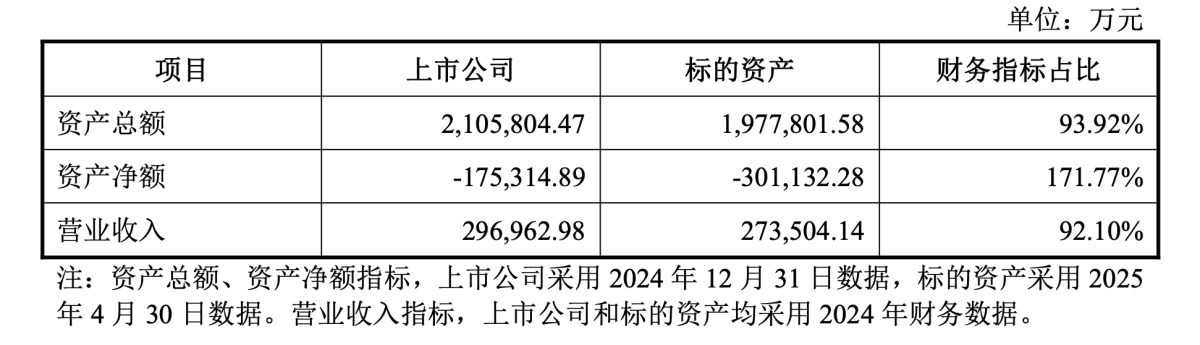
Source of table: *ST Nan Zhi announcement on September 17, 2025.
“The essence of this one-yuan transfer transaction is the assumption of negative assets. The buyer will need to assume all liabilities and future operational risks of the target company. For the seller, the aim is to divest from underperforming assets that are dragging down the listed company’s performance and avoid further losses,” noted a real estate industry analyst.
Yan Yuejin, Deputy Dean of the E-House Research Institute, believes that this move was an inevitable step taken by the company to maintain its listing status. “Such transactions are not uncommon in the A-share market, especially for listed companies facing delisting risks. Divesting from non-performing assets to retain their qualification as a listed entity is a common practice.”
Publicly available information shows that *ST Nanzhi, formerly known as South China Real Estate Development (Nanguo Zhiye), was established in 1998. It is a comprehensive development and operation enterprise guided by commercial real estate and covering various property types. In 2009, Nanguo Zhiye became the first commercial real estate company to go public after the resumption of IPOs in the real estate sector, once demonstrating strong growth momentum.
In April 2014, Power Construction Real Estate officially became the largest shareholder of South China Real Estate Development, marking the company’s transition from a private enterprise to a subsidiary of a central state-owned enterprise. With the backing of its shareholders, its business rapidly expanded to several key core cities across the country, including Beijing, Shenzhen, Guangzhou, Wuhan, and Chongqing.
However, in recent years, with the continuous adjustments in the real estate industry, *ST Nanzhi, which mainly engages in real estate development, has also been significantly affected and has been in a state of continuous losses since 2021.
Financial reports show that in 2022, 2023, and 2024, South China Real Estate Development reported net profits attributable to parent company shareholders of -RMB 823 million, -RMB 1.693 billion, and -RMB 2.238 billion, respectively. In the first half of 2025, the net profit attributable to shareholders of the listed company was -RMB 898 million, representing a year-on-year significant decline of 20,633.52%.
“The listed company’s real estate development business has continued to adversely affect the overall operating performance of the company.” According to *ST Nanzhi, at the end of 2024, the audited parent company shareholder equity was -RMB 1.753 billion. According to the relevant provisions of the Listing Rules, the company’s stock has been subject to delisting risk warnings (*ST) starting from April 30, 2025.
After the completion of this transaction, although the financial indicators such as *ST Nanzhi’s asset size, total liabilities, and revenue will significantly decrease, the company will be able to operate with a lighter structure, resulting in substantial increases in shareholders’ equity and net profit.
According to the disclosures by *ST Nanzhi, upon the completion of the transaction, the company’s prepared net profit attributable to parent company shareholders for 2024 is RMB 225 million, an increase of RMB 2.463 billion compared to before the transaction; for January-April 2025, the prepared net profit attributable to parent company shareholders is -RMB 26 million, reflecting a reduction in losses of RMB 678 million compared to before the transaction.
“Upon the completion of this transaction, the company’s business operations will shift from heavy to light, and the quality of assets will improve further, which is conducive to enhancing the profitability of the listed company and is in the interest of all shareholders of the listed company,” stated *ST Nanzhi.
However, it remains uncertain whether this transaction will enable *ST Nan置 to avoid delisting risks.
*ST Nan置 stated, ‘If the audited net assets of the listed company as of December 31, 2025 are negative, or if the lower of the audited total profit, net profit, or non-recurring net profit for the fiscal year 2025 is negative and the revenue after deductions is below RMB 300 million, then the company’s stock will face delisting upon the disclosure of the audited financial statements for the 2025 fiscal year.’
Can it leverage the ‘debt reduction’ opportunity to escape its predicament?
In fact, *ST Nan置 is not the first company to exit the real estate industry.
Under market environment pressures, many real estate companies have started seeking business transformation by selling real estate projects, divesting related operations, and gradually reducing or even exiting the real estate development sector while retaining light-asset businesses such as asset management, property management, and project construction management.
Companies like *ST Nan置 that transfer their real estate businesses for one yuan are not isolated cases.
For instance, in order to maintain its listing status, *ST Zhong地 transferred its real estate development-related assets and liabilities, which were assessed at -RMB 2.98 billion, to its controlling shareholder, China Communications Real Estate Group, for one yuan. Going forward, the company will focus on light-asset businesses such as property services and asset management and operation.
Yan Yuejin noted that since the real estate development operations of some companies are deeply mired in losses, the valuation of these real estate firms’ assets in the market has plummeted and may also carry significant liabilities. For the acquiring party, this represents a considerable burden. Therefore, transferring these assets for a symbolic price of one yuan is more akin to a ‘shedding of burdens,’ aiming to swiftly achieve debt reduction and business transformation.
As of June 30, 2025, *ST Nan置 had other accounts payable of RMB 13.357 billion at the consolidated financial statement level, facing substantial debt repayment pressure.
Analysts pointed out that for *ST Nan置, this asset transfer represents a critical strategic decision and a key step toward extricating itself from its difficulties and achieving rebirth.
Regarding future development directions, *ST Nanfang Property stated that it will further focus on light-asset businesses such as commercial operations and industrial operations within urban operations, achieving a strategic transformation into a comprehensive urban operation service provider. Additionally, to further enhance the performance scale of the listed company and strengthen its profitability, Nanfang Property plans to expand into property services business in the future.
Notably, other enterprises controlled by Power Construction Group and Power Construction Real Estate, aside from Nanfang Property, are involved in operational and property services businesses that overlap regionally with Nanfang Property’s core business.
To appropriately address competition issues in operational and property services businesses and protect the rights and interests of the listed company and its shareholders, the controlling shareholder of Nanfang Property, Power Construction Real Estate, and the ultimate controller, Power Construction Group, have committed to resolving these competition issues with Nanfang Property in stages.
“If other enterprises controlled by Power Construction Group or Power Construction Real Estate obtain any new business opportunities in the future that may compete with Nanfang Property’s core business, Power Construction Group and Power Construction Real Estate will immediately notify Nanfang Property in writing and make every effort to ensure that such business opportunities are offered to Nanfang Property first under reasonable and fair terms and conditions. If Nanfang Property declines these opportunities, other enterprises controlled by Power Construction Group or Power Construction Real Estate may only engage in them after Nanfang Property has completed relevant procedures.” A representative from Nanfang Property stated.
Industry experts believe that although the path of transformation is challenging, backed by the powerful central enterprise shareholder China Power Construction Group, the market still holds certain expectations for *ST Nanfang Property’s future development.
“This asset divestiture creates conditions for Nanfang Property to potentially receive the injection of high-quality assets from its major shareholder in the future. However, whether the transformation succeeds will depend on the company’s strategic layout and operational capabilities in new business areas, as well as its ability to effectively integrate resources to ensure a smooth transition and sustainable development.” The aforementioned analyst commented.
link