Protecting farmers or protecting institutions? An analysis of strategies to leverage high-quality development of county-specific agricultural insurance
Under the government’s pre-agreed premium subsidy (1-η)g for specialty agriculture and operating expense subsidy S to insurance companies, specialty agricultural operators exhibit strong insurance demand. However, due to insurance companies’ profitability constraints, high premiums set within the policy agricultural insurance framework may deviate from “policy” and “public welfare” attributes. Consequently, insurance companies tend to continue the traditional agricultural insurance model of “low insurance coverage and low compensation”. This creates a deviation between farmers’ risk protection needs and the actual level of agricultural insurance protection, making it difficult to effectively stimulate the demand of specialty agricultural operators. As a result, operators form a “low insurance” model. Therefore, the operators will form the “agricultural insurance can only cover part of the risk” of the expectations, which will lead to the characteristics of agricultural operators to participate in the insurance decision-making differentiation, it may be remembered that x for the characteristics of agricultural business subjects to choose the probability of [insured] strategy, then (1-x) for the probability of choosing the strategy [uninsured].
As the insurance company provides special agricultural insurance products under the break-even constraint. It needs to realize the product coverage of some market-type risks in order to pry the demand of special agricultural operators to participate in the insurance. But it also implies a rise in the pressure of risk payout, and the difficulty of the product actuarial risk beforehand, and there is a resistance to the pricing of the high premiums, so the insurance company supplying the special agricultural insurance products has a strong constraint of the operating costs. But at the same time, the insurance company to provide special agricultural insurance products, that is, has a broad market demand, but also can realize the integration of life insurance, property insurance business channels, but also by actively responding to the government’s actions can obtain potential benefits, so the insurance company exists in the [underwriting] and [non-coverage] strategy choice, may wish to record y for the insurance company to choose the probability of the [underwriting] strategy, (1-y) for the insurance company to choose the probability of the [non-coverage] strategy. strategy.
Accordingly, the initial return matrix of the static game between the specialty agricultural management subjects and insurance companies under different strategies can be calculated, and the corresponding actual returns under different strategies are detailed in Table 2:
Specialized Agricultural Business Entities:
The expected utility when [insured] is:
$${U}_{{\rm{insured}}}={\rm{y}}[{\rm{R}}-\eta {\rm{g}}+(\varphi -1){\rm{E}}(\Delta {\rm{i}})]+(1-{\rm{y}})[{\rm{R}}-{\rm{E}}(\Delta {\rm{i}})-{\rm{L}}-{\rm{T}}]$$
(1)
The expected utility when [not insured] is:
$${U}_{{\rm{not\; insured}}}={\rm{y}}[{\rm{R}}+(\delta -1){\rm{E}}(\Delta {\rm{i}})-{\rm{L}}]+(1-{\rm{y}})[{\rm{R}}-{\rm{E}}(\Delta {\rm{i}})-{\rm{L}}]$$
(2)
The average expected utility is:
$${\bar{U}}_{{\rm{specialized}}\; {\rm{agricultural}}\; {\rm{business}}\; {\rm{entities}}}={\rm{x}}\{{\rm{R}}-{\rm{E}}(\Delta {\rm{i}})-{\rm{L}}-\Delta {\rm{G}}+{\rm{y}}[-\eta g+\varphi E(\Delta {\rm{i}})+{\rm{L}}+\Delta {\rm{G}}]\}+(1-{\rm{x}})[{\rm{R}}-1{\rm{E}}(\Delta {\rm{i}})-{\rm{L}}+{\rm{y}}\delta E(\Delta {\rm{i}})]$$
(3)
The expected utility of the insurance company’s [underwriting] strategy is:
$$\begin{array}{lll}{U}_{{\rm{underwriting}}} &=& x[W+g+S-\varphi E(\Delta {\rm{A}})+{\rm{V}}]\\&&+\,(1-x)[W-\delta E(\Delta i)+{\rm{S}}]\end{array}$$
(4)
The revenue function of the insurance company when choosing the [non-coverage] strategy is:
$${U}_{{\rm{non}}-{\rm{coverage}}}=x(W-{\rm{Q}})+(1-x)W$$
(5)
Furthermore, assuming that the insurance company provides insurance products for specialized agricultural business entities, it can leverage existing agricultural insurance sales channels, outlets, and professional service personnel. As a result, no additional operating costs are incurred. The insurance company’s potential operational losses may only arise from significant risk compensation pressures and potential actuarial losses. Therefore, the average expected utility of the insurance company can be expressed as:
$${\bar{U}}_{{\rm{Insurance\; companies}}}={\rm{y}}\{x[g+V-(\varphi -\delta )E(\Delta i)]+W+S-\delta E(\Delta i)\}+(1-{\rm{x}})(W-x{\rm{Q}})$$
(6)
In the framework of evolutionary game theory with discrete strategies, the replicator dynamic equation for specialized agricultural business entities (Li and Wang, 2022) can be expressed as follows:
$$F(x)=x(1-x)\{y[L+T-\eta g+(\varphi -\delta )E(\Delta i)]-T\}$$
(7)
And the replicator dynamic equation for the insurance company entities is:
$$G(x)=y(1-y)\{x[g+V+Q-(\varphi -\delta )E(\Delta i)]+S-\delta E(\Delta i)\}$$
(8)
Given the dynamic equations of stable evolution, the five evolutionary game equilibrium points are: (0,0), (0,1), (1,0), (1,1), and E5 (x*, y*), where provide details or definitions of \({x}^{* }=\frac{\delta E(\Delta i)-S}{g+V+Q-(\varphi -\delta )E(\Delta i)}\), \({y}^{* }=\frac{T}{L+T-\eta g+(\varphi -\delta )E(\Delta i)}\) if available.
In practical terms, the dynamic perspective of the evolutionary game adopted in this study implies that the actors involved in the agricultural insurance market (government, farmers and insurance companies) do not make one-time decisions. Instead, they continuously adjust their strategies in a changing market environment.
For example, an insurance company does not offer brand new contracts in every period. It will adjust its underwriting strategy and the specific terms of the insurance contract according to changes in market feedback, payouts, government subsidy policies, and farmers’ insurance participation behavior. If the damage to specialty agricultural products in a certain period exceeds expectations and the amount of payout increases, the insurance company may raise the premiums of some insurance products or adjust the indemnity coefficients in the subsequent period in order to balance the income and expenditure and control the risks.
For the government, although it will not change its subsidy policy frequently and drastically, it will adjust the level and manner of the subsidy policy at the right time in accordance with the overall development of the agricultural insurance market, the financial situation and the extent to which the policy objectives have been achieved. For example, if it is found that the underwriting incentive of insurance companies is not high or the participation rate of farmers does not meet expectations, the Government may appropriately raise the operating cost subsidy for insurance companies or increase the proportion of premium subsidy for farmers to stimulate market supply and demand.
This dynamic adjustment process is reflected in the return matrix (e.g., Table 3). The value of each return in the matrix will change with the change of each subject’s strategy. In each round of the game, each subject will adjust its own strategy according to the current return situation and the expectation of the future. This adjustment in turn affects the outcome of the next round of the game. The whole market evolves in such a dynamic process until it reaches a stable equilibrium state.
In the dynamic strategy space of continuous games, the stability of equilibrium points actually depends on the strategy convergence stability of the system’s Jacobian matrix. The following is a stability analysis of the Jacobian matrix. For convenience of expression, letters A to G are used to represent the corresponding parts of the payoff matrix. The correspondence is shown in Table 3.
The Jacobian matrix is given by:
$$J=\left|\begin{array}{cc}{(1-2y)}^{* }\left[{({\rm{E}}-{\rm{F}}+{\rm{H}}-{\rm{G}})}^{* }x-({\rm{H}}-{\rm{G}})\right] & {({\rm{E}}-{\rm{F}}+{\rm{H}}-{\rm{G}})}^{* }{y}^{* }(1-{\rm{y}})\\ -{({\rm{B}}-{\rm{D}}+{\rm{C}}-{\rm{A}})}^{* }{x}^{* }(1-{\rm{x}}) & {(1-2x)}^{* }\left[({\rm{B}}-{\rm{D}})-{({\rm{B}}-{\rm{D}}+{\rm{C}}-{\rm{A}})}^{* }y\right]\end{array}\right|$$
(9)
From this, the determinant of matrix J is:
$$\begin{array}{l}\det J={(1-2y)}^{* }{\left[{({\rm{E}}-{\rm{F}}+{\rm{H}}-{\rm{G}})}^{* }{\rm{x}}-({\rm{H}}-{\rm{G}})\right]}^{* }{({\rm{l}}-2x)}^{* }\left[({\rm{B}}-{\rm{D}})-{({\rm{B}}-{\rm{D}}+{\rm{C}}-{\rm{A}})}^{* }y\right]\\ +{({\rm{E}}-{\rm{F}}+{\rm{H}}-{\rm{G}})}^{* }{y}^{* }{(1-{\rm{y}})}^{* }{(A-C+D-B)}^{* }{x}^{* }(1-x)\end{array}$$
(10)
The trace of the matrix is:
$${\rm{tr}}\,J=(1-2y)* \left[{({\rm{E}}-{\rm{F}}+{\rm{H}}-{\rm{G}})}^{* }x-({\rm{H}}-{\rm{G}})\right]+\,{(1-2x)}^{* }\left[({\rm{B}}-{\rm{D}})-{({\rm{B}}-{\rm{D}}+{\rm{C}}-{\rm{A}})}^{* }y\right]$$
(11)
Substituting the payoff matrix into these expressions yields:
$$\begin{array}{l}A-C=(\varphi -\delta )E(\Delta i)+L-\eta g\\ B-D=-T\\ E-F=g+S-\varphi E(\Delta i)+V+Q\\ G-H=S-\delta E(\Delta i)\end{array}$$
(12)
The equilibrium point analysis is summarized in Table 4 as follows:
For specialized agricultural business entities, unlike staple crop products, the lack of a price protection mechanism results in a higher proportion of market volatility risk within their risk structure. Under the constraints of significant upfront capital investment, farmers typically lack alternative mechanisms for risk diversification. Therefore, they exhibit a stronger willingness to smooth risk expectations through agricultural insurance participation and display a more pronounced risk-averse preference. In fact, the new agricultural operators, due to their reliance on a single crop variety and high-risk concentration, as well as a lack of non-agricultural income compensation, demonstrate a stronger preference for agricultural insurance participation (Ye and Zhu, 2018). In this case, A − C > 0 and B − D < 0, indicating that specialized agricultural business entities have a strong willingness to purchase insurance given the effective supply of agricultural insurance products. Therefore, the distribution of equilibrium points in the strategy game in Table 4 mainly depends on the signs of E − F and G − H, as discussed below:
1. E-F > 0, G-H > 0
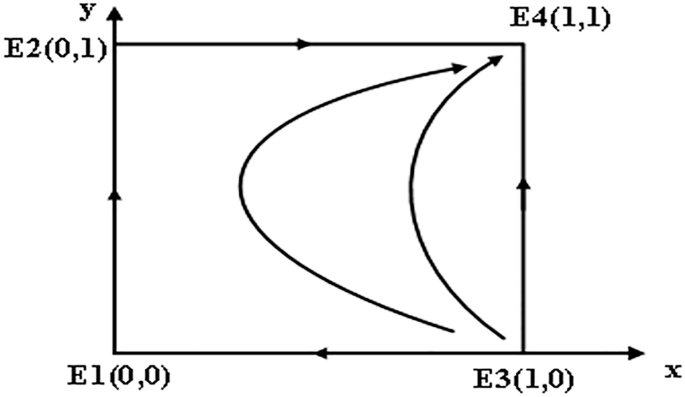
At this point, the replicated dynamic system has four strategy equilibrium points, namely E1(0,0), E2(0,1), E3(1,0), E4(1,1). Their stability properties are shown in Table 5 and Fig. 1.

Stability analysis results of equilibrium point when E-F > 0 and G-H > 0.
At this point, all other convergence points are either saddle points or unstable points, with only the point (1,1) being a stable game convergence strategy. This means that the game ultimately converges to the [insured, underwriting] strategy.
In reality, this situation shows that when the insurance company can obtain positive returns from operating specialty agricultural insurance. When government subsidies and other factors make the relevant conditions satisfied, farmers and insurance companies will eventually reach a strategic combination of [insured, underwriting]. This means that the agricultural insurance market can realize a good match between supply and demand. Farmers are willing to participate in insurance to protect their own risks, insurance companies have incentives to provide insurance services, and the market tends to develop stably.
2. E-F > 0, G-H < 0
At this point, in addition to the original equilibrium points E1(0,0), E2(0,1), E3(1,0), E4(1,1), the replicated dynamic system presents a new equilibrium point, E5(x*, y*), where
$$\begin{array}{c}{y}^{* }=\frac{B-D}{B-D+C-A}=\frac{-{\rm{T}}}{-{\rm{T}}+\eta G-L-\varphi E(\Delta i)+\delta E(\Delta i)}\\ {x}^{* }=\frac{H-G}{E-F+H-G}=\frac{\delta E(\Delta i)-S}{g+S-\varphi E(\Delta i)+V+Q-S+\delta E(\Delta i)}\end{array}$$
(13)
The results of the stability analysis of each equilibrium point are shown in Table 6 and Fig. 2.

Stability analysis results of equilibrium point when E-F > 0 and G-H < 0.
At this point, the only stable game strategy convergence point remains (1,1), with the multi-agent game ultimately converging to the [insured, underwriting] strategy.
From a realistic point of view, despite the emergence of a new equilibrium point, the final multi-subject game still converges to the [insured, underwritten] strategy. This suggests that even if certain combinations of government subsidies and market factors change. As long as the insurance company operates the specialty agricultural insurance with positive profit, the market can still reach the ideal stable state, and the interests of farmers and insurance companies can be coordinated in this situation.
3. E-F < 0, G-H > 0
At this point, the equilibrium point distribution of the replicated dynamic system includes E1(0,0), E2(0,1), E3(1,0), E4(1,1), E5(x*, y*), where
$$\begin{array}{c}{y}^{* }=\frac{B-D}{B-D+C-A}=\frac{-{\rm{T}}}{-{\rm{T}}+\eta G-L-\varphi E(\Delta i)+\delta E(\Delta i)}\\ {x}^{* }=\frac{H-G}{E-F+H-G}=\frac{\delta E(\Delta i)-S}{g+S-\varphi E(\Delta i)+V+Q-S+\delta E(\Delta i)}\end{array}$$
(14)
The results of the equilibrium point stability analysis can be found in Table 7 and Fig. 3.

Stability analysis results of equilibrium point when E-F < 0, G-H > 0.
As shown in Fig. 3, there is no pure strategy equilibrium at this point, with the equilibrium point being E5. In this case, the system will struggle to achieve a static equilibrium in the game, and the interaction between farmers and the insurance company will exhibit repeated dynamic strategy adjustments, making it difficult to form a final stable convergence strategy.
In the actual agricultural insurance market, this situation reflects the fact that when the insurance company operates the featured agricultural insurance with negative profitability, the system is difficult to reach static equilibrium, and the strategies between farmers and insurance companies will be constantly adjusted dynamically. This may lead to the market in an unstable state, and it is difficult for both parties to form a stable cooperative relationship, which is not conducive to the sustainability of agricultural insurance business.
4. E-F < 0, G-H < 0
At this point, the equilibrium points of the replicated dynamic system are reduced to four: E1(0,0), E2(0,1), E3(1,0), E4(1,1). The stability results of each equilibrium point are shown in Table 8 and Fig. 4.

Stability analysis results of equilibrium point when E-F < 0, G-H < 0.
At this point, the dominant strategy for both farmers and the insurance company is [uninsured, non-coverage], leading both parties to exit the agricultural insurance market.
This situation means that both farmers and insurance companies tend to choose the strategy of [uninsured, non-coverage], and both parties withdraw from the agricultural insurance market. This suggests that in the case of poor profitability and other unfavorable conditions for insurance companies, the agricultural insurance market will shrink. It will not be able to provide risk protection for farmers, which will hinder the stable development of agriculture.
In summary, considering that only stable equilibrium points can ultimately become the preferred strategies for game participants in continuous games, while unstable equilibrium points will continuously adjust and fluctuate, this indicates that only when specialized agricultural insurance companies have positive profits (E – F > 0) will underwriting become the dominant strategy. This ensures the achievement of a stable equilibrium at (E4(1,1). However, when the profits of specialized agricultural insurance companies are negative (E – F < 0), even if the company receives government subsidies S for operational costs and ensures that G – H < 0, the dominant strategy for the insurance company will still be [no underwriting]. In this scenario, the government’s operational cost subsidy ensures that the insurance company does not incur losses and serves as the sole condition supporting the provision of insurance products.
Comparing the two differentiated subsidy models of the government, under the assumption of bounded rationality, local governments are unable to accurately predict the actual market size after providing insurance subsidies. Therefore, in practice, financial subsidies for specialized agriculture in China have mostly adopted a pre-determined model, where the government commits to providing premium subsidies for agricultural insurance at a fixed rate for farmers. However, since insurance companies face significant moral hazard losses when offering underwriting services for specialized agricultural products and lack sufficient actuarial data to achieve “low-margin” operations, to ensure E − F > 0, the insurance company’s strategic options are either to increase the premium g that farmers must pay for participation or to limit the scale of insurance services, thus restricting the number of insured farmers. The ultimate result is either an increase in fiscal subsidy pressure, which dampens farmers’ willingness to participate in insurance, or agricultural insurance services being offered on a small scale, leading to the phenomenon of “one loss and it stops, one trial and it ends”.
In contrast, if the government adjusts the subsidy model from “Protecting farmer” to “Protecting institutions,” while keeping the premium g constant, the direct subsidies to farmers are eliminated. This indeed reduces the incentives for farmers to participate in insurance. However, given that new specialized agricultural operators have higher profitability, a concentrated risk structure, and strong demand for risk protection, the weakened incentive impact can be effectively offset. At the same time, direct subsidies to insurance companies ensure that they can provide insurance services to specialized agricultural operators on a larger scale. Under the direct subsidy approach, the impact of user scale is effectively controlled, allowing insurance companies to stabilize and observe the break-even point from E − F > 0 to E − F < 0. Transitioning from “Protecting farmer” to “Protecting institutions” still involves business scale limitations but can effectively stimulate the supply of specialized agricultural insurance, ensuring that insurance services are provided on a larger scale.
The evolutionary game analysis confirms that government policy subsidies (S) to specialized agricultural insurance companies can effectively drive product innovation and supply, ensuring “insurance availability for willing participants” within an ideal market scale. The theoretical basis for government premium subsidies at coefficient (1−η) stems from agriculture’s public good nature, aligning with China’s “policy + market” agricultural insurance framework. This framework provides comprehensive coverage for basic agriculture and selective coverage for specialized sectors. While directly stimulating farmer demand, the “subsidizing farmers” model imposes significant operational cost pressures on insurance companies when services shift to new agricultural operators. This discourages innovation, expands services, and accurately identifying break-even points, fostering a “fear of difficulty/loss” mentality. Adjusting risk allocation among farmers, insurers, and the government—clarifying new operators’ risk-bearing capacity and needs—along with moderating the rigid “low-premium” model to “moderate premiums with high compensation” can establish a reasonable cost-sharing structure. Stimulating insurers to supply specialized products via a “market-oriented, policy-supported” approach offers a feasible path to expand the “policy + market” model to local specialized agriculture and accelerate agricultural insurance’s high-quality development.
link